
India’s relationship with its film stars often transcends mere admiration, evolving into a fervent form of devotion that blurs the boundaries between entertainment, faith, and politics. From frenzied fans writing letters in blood to temples erected in honour of actors, this celebrity worship reflects deep cultural, emotional, and social undercurrents. While it provides stars with unparalleled influence and loyalty, it also raises serious questions about rationality, democratic values, and the risks of unchecked hero worship.
This phenomenon is most pronounced in South India, particularly Tamil Nadu, where cinema and politics have long been intertwined. Icons like M.G. Ramachandran (MGR), Rajinikanth, and more recently Vijay exemplify how on-screen charisma can translate into real-world power, sometimes with profound consequences for governance and society.
The Extreme Devotion: From Blood Letters to Temples
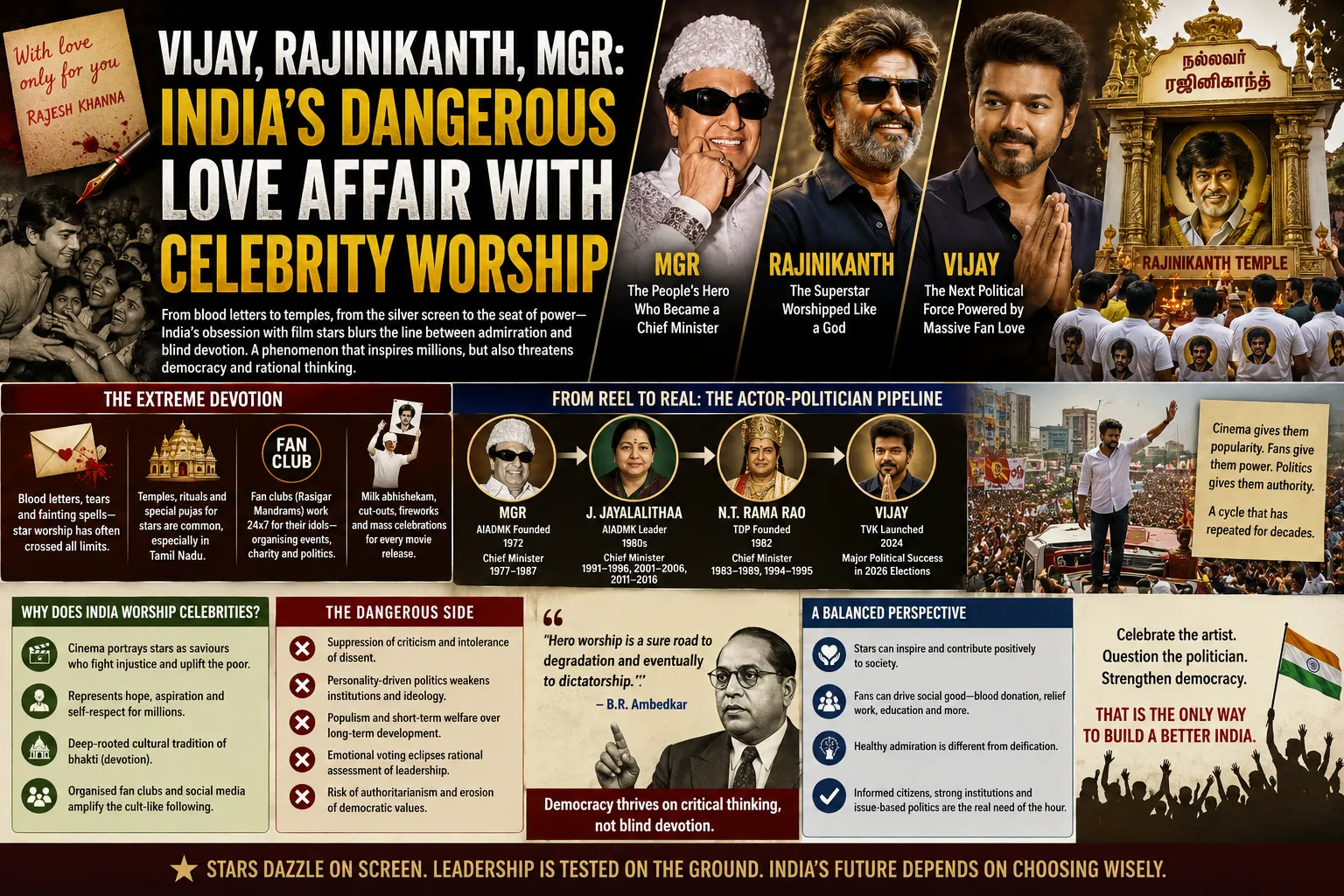
One of the most striking examples of this obsession dates back to the 1960s and 1970s with Bollywood superstar Rajesh Khanna. At the peak of his fame, female fans expressed their adoration in extreme ways, including writing love letters in their own blood. Khanna himself later recounted receiving such letters and even discussing them with his mother, highlighting the hysteria that surrounded him. Crowds would gather in massive numbers for his public appearances, and his popularity created a template for the superstar culture that followed.
In Tamil cinema, this devotion reaches near-religious heights. Rajinikanth, affectionately called “Thalaivar” (leader), has temples dedicated to him by devoted fans. These structures treat the actor as a deity, with rituals performed in his honour. His larger-than-life screen persona — often that of a righteous, larger-than-life hero who defies odds — resonates deeply with the masses, many of whom see him as a symbol of hope and justice. Fan celebrations for his film releases often resemble festivals, complete with processions, prayers, and collective euphoria.
Similarly, actor Vijay, known as “Thalapathy,” commands a massive, youthful following. His dedicated fan clubs, known as rasigar mandrams, have evolved from organising film promotions to grassroots political mobilisation. Reports of fans reacting emotionally to his career milestones, including tears of joy during political successes, underscore the personal connection many feel. In some cases, extreme reactions such as stampedes during public events have even resulted in tragic loss of life.
These expressions of fandom are not limited to isolated incidents. Across India, cut-outs of stars are garlanded, milk is poured over posters during successes, and fan clubs engage in social service — blood donation drives, eye camps, and disaster relief — to honour their idols. While this demonstrates community spirit, it also reveals how deeply celebrities are embedded in the cultural and emotional fabric of society.
From Reel to Real: The Actor-Politician Pipeline
The most significant outcome of this celebrity worship is its seamless translation into political power. MGR remains the archetype. A hugely popular actor known for his heroic roles, MGR transitioned into politics by joining the Dravida Munnetra Kazhagam (DMK) before founding his own party, the All India Anna Dravida Munnetra Kazhagam (AIADMK), in 1972. His on-screen image as a champion of the poor helped him win the hearts of the working class. He served as Chief Minister of Tamil Nadu from 1977 until his death in 1987, winning multiple elections through a combination of populist welfare schemes and unwavering fan loyalty.
MGR’s success set a precedent. His protégé, J. Jayalalithaa, another former actor, later led the same party and became Chief Minister. In Andhra Pradesh, N.T. Rama Rao followed a similar path. This model continues today with Vijay, who launched the Tamilaga Vettri Kazhagam (TVK) party and achieved notable political success in the 2026 Tamil Nadu elections, drawing direct comparisons to MGR’s trajectory. Vijay’s fan network provided a ready-made organisational structure, helping transform emotional allegiance into electoral strength.
Rajinikanth has flirted with politics for years, often teasing a full entry but ultimately stepping back. His massive influence, however, continues to shape Tamil Nadu’s political discourse.
Why Does India Worship Celebrities Like Gods?
Several factors explain this intense phenomenon. Indian cinema, especially in the South, often portrays actors as saviours who fight corruption, protect the vulnerable, and uphold justice — themes that resonate in a society grappling with inequality and systemic challenges. For many fans from marginalised backgrounds, these larger-than-life figures represent aspiration and empowerment.
Cultural elements also play a role. India has a long tradition of bhakti (devotional) movements, where intense personal devotion is channelled toward deities or gurus. This emotional framework easily extends to charismatic public figures. Additionally, limited access to diverse role models in certain communities amplifies the influence of film stars.
Social media and organised fan clubs have amplified this worship in the digital age, creating echo chambers where criticism of idols is often met with hostility. This can stifle healthy debate and foster intolerance.
The Dangerous Side of Hero Worship
While celebrity admiration can inspire and entertain, its excesses carry significant risks. B.R. Ambedkar famously warned that “hero worship is a sure road to degradation and eventually to dictatorship.” When voters choose leaders based primarily on cinematic charisma rather than governance track records, policy substance, or administrative competence, it can undermine democratic accountability.
Blind devotion often leads to:
-
Suppression of Criticism: Questioning a star’s decisions or policies can trigger backlash, reducing space for constructive discourse.
-
Personality-Driven Politics: Governance becomes centred on individual appeal rather than institutional strength or ideological clarity.
-
Populism Over Pragmatism: Leaders may prioritise short-term welfare measures or dramatic gestures to maintain fan loyalty at the expense of long-term sustainable development.
-
Emotional rather than Rational Decision-Making: Voters influenced by cinematic nostalgia or mass hysteria may overlook corruption, inefficiency, or lack of vision.
Historical examples show how unchecked hero worship can concentrate power dangerously. In extreme cases, it blurs the line between public service and personal cult, weakening democratic institutions.
Finding a Balanced Perspective
Celebrity culture is not inherently negative. Stars like Rajinikanth and Vijay have used their influence for positive causes, including disaster relief and social awareness. Fan clubs often perform genuine public service. The energy and passion of fans can drive positive social mobilisation when channelled constructively.
The challenge lies in moderation. Healthy admiration that appreciates artistic talent and hard work is different from deification that suspends critical thinking. Encouraging media literacy, stronger institutions, and voter education can help citizens separate reel heroism from real-world governance requirements.
As new-generation stars like Vijay navigate the shift from cinema to politics, India must reflect on this enduring love affair. Cinema will always hold a special place in Indian society as a source of joy, escapism, and cultural identity. However, transforming screen idols into infallible political deities risks weakening the very democracy that allows such stars to thrive.
The story of Vijay, Rajinikanth, MGR, and countless others is ultimately a mirror to Indian society — one that reveals both the deep emotional needs of the people and the urgent necessity for mature, issue-based political engagement. Striking the right balance between celebration and critical evaluation remains one of the enduring challenges for Indian democracy.
pressnbcnews pressnbcnews pressnbcnews pressnbcnews pressnbcnews pressnbcnews pressnbcnews pressnbcnews pressnbcnews pressnbcnews pressnbcnews pressnbcnews pressnbcnews pressnbcnews pressnbcnews pressnbcnews pressnbcnews pressnbcnews pressnbcnews pressnbcnews pressnbcnews pressnbcnews pressnbcnews pressnbcnews pressnbcnews pressnbcnews pressnbcnews pressnbcnews pressnbcnews pressnbcnews pressnbcnews pressnbcnews pressnbcnews pressnbcnews pressnbcnews pressnbcnews pressnbcnews pressnbcnews pressnbcnews pressnbcnews pressnbcnews pressnbcnews pressnbcnews pressnbcnews pressnbcnews pressnbcnews pressnbcnews pressnbcnews pressnbcnews pressnbcnews pressnbcnews pressnbcnews pressnbcnews pressnbcnews pressnbcnews pressnbcnews pressnbcnews pressnbcnews pressnbcnews pressnbcnews pressnbcnews pressnbcnews pressnbcnews pressnbcnews pressnbcnews pressnbcnews pressnbcnews pressnbcnews pressnbcnews pressnbcnews pressnbcnews pressnbcnews pressnbcnews pressnbcnews pressnbcnews pressnbcnews pressnbcnews pressnbcnews pressnbcnews pressnbcnews pressnbcnews pressnbcnews pressnbcnews pressnbcnews pressnbcnews pressnbcnews pressnbcnews pressnbcnews pressnbcnews pressnbcnews pressnbcnews pressnbcnews pressnbcnews pressnbcnews pressnbcnews pressnbcnews pressnbcnews pressnbcnews pressnbcnews pressnbcnews pressnbcnews pressnbcnews pressnbcnews pressnbcnews pressnbcnews pressnbcnews pressnbcnews pressnbcnews pressnbcnews pressnbcnews pressnbcnews pressnbcnews pressnbcnews pressnbcnews pressnbcnews pressnbcnews pressnbcnews pressnbcnews pressnbcnews pressnbcnews pressnbcnews pressnbcnews pressnbcnews pressnbcnews pressnbcnews pressnbcnews pressnbcnews pressnbcnews pressnbcnews pressnbcnews pressnbcnews pressnbcnews pressnbcnews pressnbcnews pressnbcnews pressnbcnews pressnbcnews pressnbcnews pressnbcnews pressnbcnews pressnbcnews pressnbcnews pressnbcnews pressnbcnews pressnbcnews pressnbcnews pressnbcnews pressnbcnews pressnbcnews pressnbcnews pressnbcnews pressnbcnews pressnbcnews pressnbcnews pressnbcnews pressnbcnews pressnbcnews pressnbcnews pressnbcnews pressnbcnews pressnbcnews pressnbcnews pressnbcnews pressnbcnews pressnbcnews pressnbcnews pressnbcnews